Ikkibawikrrr in conversation with Gabriel Gee
July 2023 Seoul
Transcription arranged by Olivia Shook
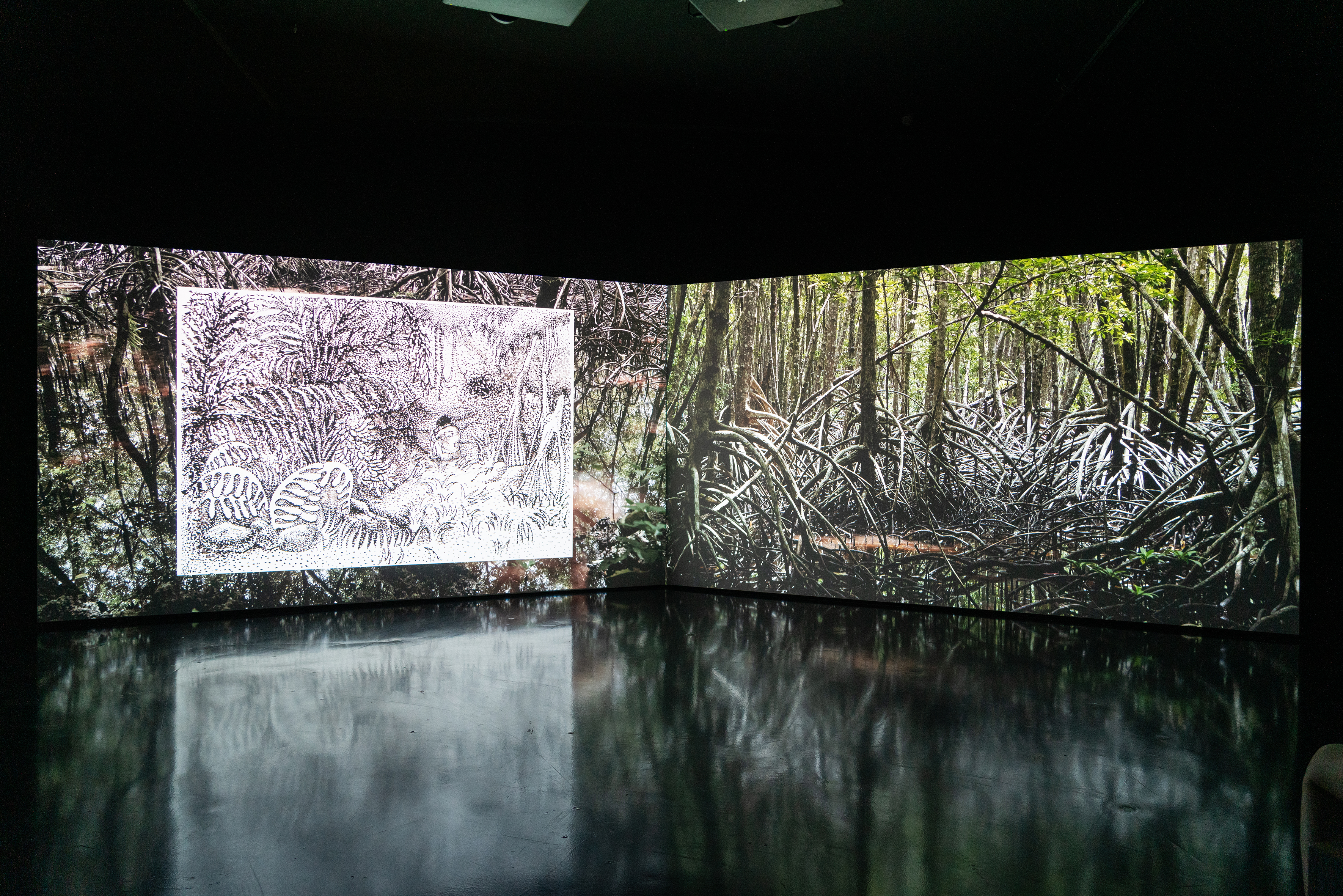 Tropical Story @Ikkibawikrrr
Gabriel Gee: As part of this year's 2023 Gwangju Biennial, you are showing Tropical Story (2022), a work that captures a set of maritime entanglements and traces of war in the Pacific Ocean revolving in particular around Jeju Island, to the South West of the Korean Peninsula. Can I ask you how this project started? How did you decide to focus on the motifs that recur in the video footage: the airline, air fields, the underground cave, and the sea?
Cho Jieun/Kim Jungwon: We have had a long interest in Jeju Island. We met people from Jeju who moved to Japan after the colonial period. Many people moved away from Jeju, because of the massacre that took place on April 3rd 1948 in Jeju. There were many communists and there was a massacre against them, so these islanders moved during this period to Japan. We also found out that while many went to Japan, many also went to the southern Pacific Ocean and islands during the colonial period. So there are people who moved to several islands in the Pacific Ocean, for example like Saipan, Guam, Palau. That was also at the time of the Pacific war period.
Gabriel Gee: In the film, several islands are included.
Cho Jieun/Kim Jungwon: There are many locations. Korean people went there for work. From the pre-1920s until 1945 before the war ended, many Korean and Chinese people went to these Islands for mining, for working, and they were also forced to participate in the war. We had a strong interest in those histories. Also mixrice had a long interest in the stories of migrant workers. From this interest, we started to visit those islands and documented several locations related to the Pacific War. And we have always had a curiosity about the South, and how is the South compared to us here in the North? So we tried to follow the South. And we found that it was tropical, so that's why we called it a tropical story.
During the field trip around these islands, we could imagine that when Korean people went to the southern islands, they would encounter a totally different environment. It could be a strange experience for them, a strange scenery, with strange plants. We started this work in 2018, and we developed this piece for the Kassel Documenta. We started shooting since 2018, and made a first version of the tropical story. For the piece at Gwangju Biennal, we used some footage from the previous work and added new shooting.
Gabriel Gee: Besides the video, there are also the photographs and drawing in the Gwangju installation as part of the piece.
Cho Jieun/Kim Jungwon: The drawings were added at the Gwangju Biennale for Tropical Story. In Documenta we showed some photos and videos and other works. This time we developed it with the drawing, because the drawing is a reference to a book. Also, we put some imaginary scenery that we encountered in the islands of the Pacific Ocean. So the book is kind of biographic, like a diary from a Korean who moved to an island for work and settled down there even after the Pacific War. His name is Kyung Woon Jeon.
Gabriel Gee: So is the diary a published book, or is it more personal?
Cho Jieun/Kim Jungwon: It's published. He [Kyung Woon Jeon] worked for a Japanese company, so he worked on several islands on the Pacific Ocean and he documented the work for himself. He drew and wrote his own biography before he died. Then a scholar found his document and published the book with some editing, so the drawings are references to past sceneries of islands.
And Cho Jieun copied his drawing. She thought it would be helpful to understand that period, because we never experienced that time, that scenery, or that environment. While she was following the drawings, she could feel how the people were described and how they lived. The person who edited the book is a social scientist. He taught on Jeju Island, at Jeju University. We got a lot of help from him. We learned the history from his research. He also taught us with personal lessons before we went on a field trip to get the reference for our work. His name is Professor Cho Sung Yoon.
It is rare to find personal documents from Koreans During the colonial era, because most people were under-educated, or poor. But Kyung Woon Jeon was a high school graduate. At that time, he was already educated, he went to college, an unusual thing during that era. As I read the book, it seemed he realized how it is important to retain documentation and records of his life. He had lived in the islands his whole life, so it was an important reference for us to imagine the past, as we can only saw the recent scenery in the islands.
Gabriel Gee: You have been interested in migration, but also in memory? We see layers of history that are also becoming distant at the same time.
Cho Jieun /Kim Jungwon: Yes, we could say we also tried to make some distance, because history is a huge story.
At the beginning of this work, we also found the runways from the island. We felt strange that there is a huge runway on such small islands. The native island people and Korean people were forced to build the runway during the Pacific War.
Gabriel Gee: Was it for military strategic reasons?
Cho Jieun/Kim Jungwon: Most of the runways on the island were built during the Pacific War. Also, the Jeju Airport was built for the military strategy by the Japanese army.
Gabriel Gee: You mentioned that the piece evolved from the Documenta to the Gwangju Biennial. Could it develop new extensions?
Cho Jieun/Kim Jungwon: Haha, yeah, that is a big concern! After we finished the work, we said, “Let's finish!” We were so exhausted and we had visited so many islands over these years. But deep in our hearts, we knew that we had missed islands that we couldn’t explore, for example Okinawa or Yap Island. So now we cannot say that we will extend the work, but…!
And it would cost a lot to continue the Tropical Story, because we are three members
Tropical Story @Ikkibawikrrr
Gabriel Gee: As part of this year's 2023 Gwangju Biennial, you are showing Tropical Story (2022), a work that captures a set of maritime entanglements and traces of war in the Pacific Ocean revolving in particular around Jeju Island, to the South West of the Korean Peninsula. Can I ask you how this project started? How did you decide to focus on the motifs that recur in the video footage: the airline, air fields, the underground cave, and the sea?
Cho Jieun/Kim Jungwon: We have had a long interest in Jeju Island. We met people from Jeju who moved to Japan after the colonial period. Many people moved away from Jeju, because of the massacre that took place on April 3rd 1948 in Jeju. There were many communists and there was a massacre against them, so these islanders moved during this period to Japan. We also found out that while many went to Japan, many also went to the southern Pacific Ocean and islands during the colonial period. So there are people who moved to several islands in the Pacific Ocean, for example like Saipan, Guam, Palau. That was also at the time of the Pacific war period.
Gabriel Gee: In the film, several islands are included.
Cho Jieun/Kim Jungwon: There are many locations. Korean people went there for work. From the pre-1920s until 1945 before the war ended, many Korean and Chinese people went to these Islands for mining, for working, and they were also forced to participate in the war. We had a strong interest in those histories. Also mixrice had a long interest in the stories of migrant workers. From this interest, we started to visit those islands and documented several locations related to the Pacific War. And we have always had a curiosity about the South, and how is the South compared to us here in the North? So we tried to follow the South. And we found that it was tropical, so that's why we called it a tropical story.
During the field trip around these islands, we could imagine that when Korean people went to the southern islands, they would encounter a totally different environment. It could be a strange experience for them, a strange scenery, with strange plants. We started this work in 2018, and we developed this piece for the Kassel Documenta. We started shooting since 2018, and made a first version of the tropical story. For the piece at Gwangju Biennal, we used some footage from the previous work and added new shooting.
Gabriel Gee: Besides the video, there are also the photographs and drawing in the Gwangju installation as part of the piece.
Cho Jieun/Kim Jungwon: The drawings were added at the Gwangju Biennale for Tropical Story. In Documenta we showed some photos and videos and other works. This time we developed it with the drawing, because the drawing is a reference to a book. Also, we put some imaginary scenery that we encountered in the islands of the Pacific Ocean. So the book is kind of biographic, like a diary from a Korean who moved to an island for work and settled down there even after the Pacific War. His name is Kyung Woon Jeon.
Gabriel Gee: So is the diary a published book, or is it more personal?
Cho Jieun/Kim Jungwon: It's published. He [Kyung Woon Jeon] worked for a Japanese company, so he worked on several islands on the Pacific Ocean and he documented the work for himself. He drew and wrote his own biography before he died. Then a scholar found his document and published the book with some editing, so the drawings are references to past sceneries of islands.
And Cho Jieun copied his drawing. She thought it would be helpful to understand that period, because we never experienced that time, that scenery, or that environment. While she was following the drawings, she could feel how the people were described and how they lived. The person who edited the book is a social scientist. He taught on Jeju Island, at Jeju University. We got a lot of help from him. We learned the history from his research. He also taught us with personal lessons before we went on a field trip to get the reference for our work. His name is Professor Cho Sung Yoon.
It is rare to find personal documents from Koreans During the colonial era, because most people were under-educated, or poor. But Kyung Woon Jeon was a high school graduate. At that time, he was already educated, he went to college, an unusual thing during that era. As I read the book, it seemed he realized how it is important to retain documentation and records of his life. He had lived in the islands his whole life, so it was an important reference for us to imagine the past, as we can only saw the recent scenery in the islands.
Gabriel Gee: You have been interested in migration, but also in memory? We see layers of history that are also becoming distant at the same time.
Cho Jieun /Kim Jungwon: Yes, we could say we also tried to make some distance, because history is a huge story.
At the beginning of this work, we also found the runways from the island. We felt strange that there is a huge runway on such small islands. The native island people and Korean people were forced to build the runway during the Pacific War.
Gabriel Gee: Was it for military strategic reasons?
Cho Jieun/Kim Jungwon: Most of the runways on the island were built during the Pacific War. Also, the Jeju Airport was built for the military strategy by the Japanese army.
Gabriel Gee: You mentioned that the piece evolved from the Documenta to the Gwangju Biennial. Could it develop new extensions?
Cho Jieun/Kim Jungwon: Haha, yeah, that is a big concern! After we finished the work, we said, “Let's finish!” We were so exhausted and we had visited so many islands over these years. But deep in our hearts, we knew that we had missed islands that we couldn’t explore, for example Okinawa or Yap Island. So now we cannot say that we will extend the work, but…!
And it would cost a lot to continue the Tropical Story, because we are three members 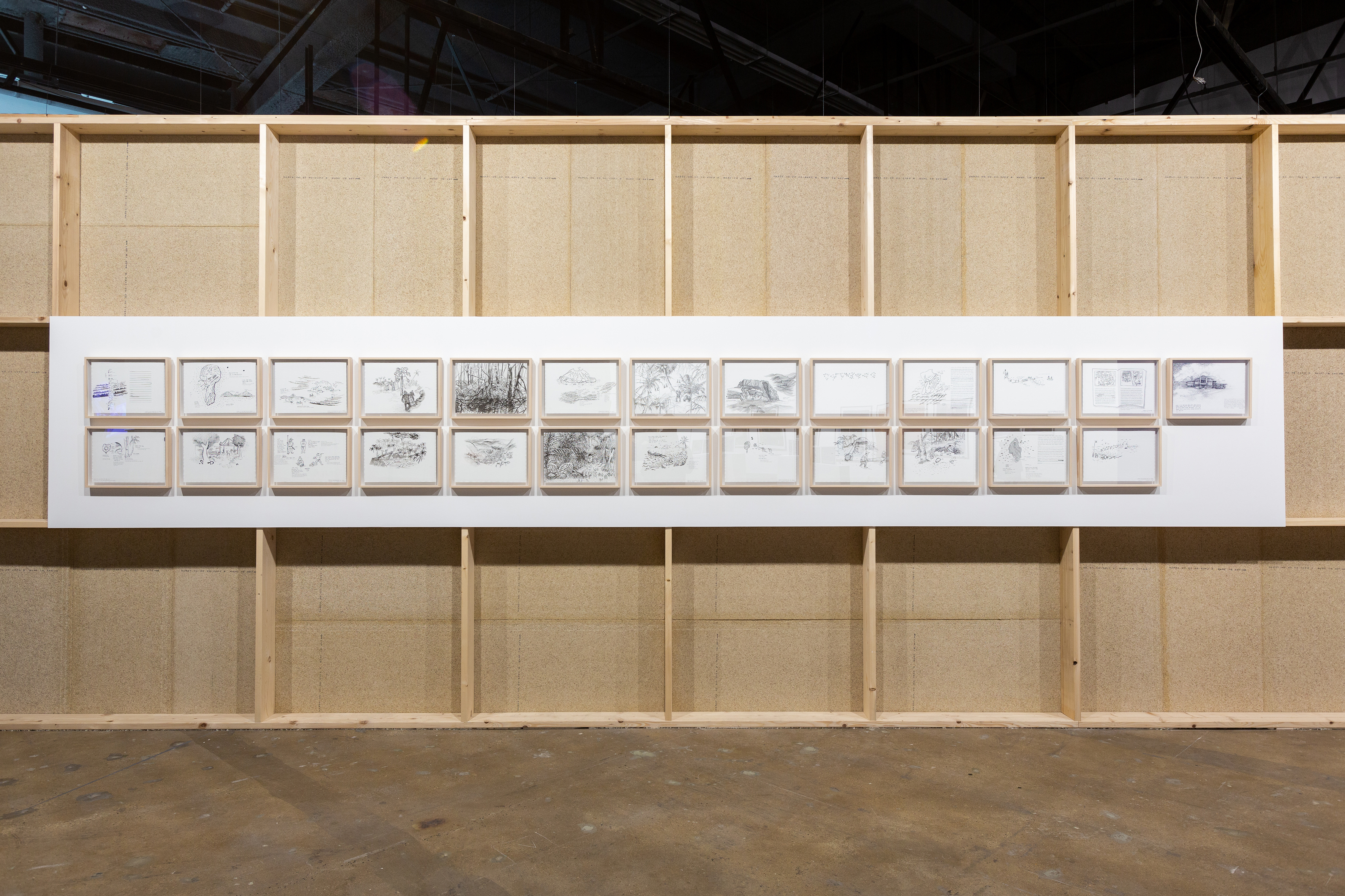 Footnotes to Tropical Story (2022-2023)@Ikkibawikrrr
Gabriel Gee. You made several works in Maseok, such as 21st century light of the factory, also looking at people and community experience… Is this still ongoing?
Kim Jungwon: Recently, there have been no specific projects in Maseok, but we still have a good relationship with the people who live there. For example, we just borrowed some space to make our work. We hang out with the friends in Maseok
Gabriel Gee: But how did this start, this interest?
Cho Jieun/Kim Jungwon: In 2006, Jieun just found Maseok as an interesting area and then she asked a friend who is a migrant worker if they had any connection or any people who they knew who lived in Maseok and they found some friends of friends, friends of cousins. So then that’s how she started to work in Maseok, in 2006.
Cho Jieun: I met the ** (33:29) community, and now I have a relationship with the Bangladesh community.
Gabriel Gee: Yes, I was going to ask because there were recurring contacts in Bangladesh as well?
Kim Jungwon/Cho Jieun: This was a long time ago, Jieun went to Nepal and Bangladesh following the migrant worker who was kicked out from Korea. She made some interviews then, in 2005.
Gabriel Gee: It's interesting to think that in Tropical Story and Seaweed Story, while it's about people, it also deals with territories, and, with seaweed, with plants, which appear to have been a recurring inspiration and source of interest. In previous work, you have also looked at abandoned plants, plants repurposed. In some earlier projects, there was a point being made about the changing relationships of humans to plants, to nature. I am thinking of the Vine Chronicles, for instance. From plants that had spiritual or religious associations, to decoration.
Kim Jungwon/Cho Jieun: It's quite difficult to explain how we involved plants… Jieun was naturally interested in plants because she moved to the countryside maybe around 2010, and during that time there were many developments in cities, authorities had started planting trees artificially, they went to the countryside to buy the trees. So she always had that kind of interest and it came just kind of naturally, just showing the world and continuing with the Seaweed. We also had interest in the oceans. Korea is surrounded by oceans, and we always feel isolated. we started to have this interest in the Ocean and we developed that.
Gabriel Gee: There is also a growing interest both in artistic research and in academics in Ocean spaces and histories. Is this something that you will be pursuing in the future?
Kim Jungwon/Cho Jieun: Yes, we will try to develop some works about the oceans. But these are not concrete plans. We are just now starting to think of possible entry points… But we certainly have some interest in the ocean. We are also aware now that many people have interest in seaweed, such as climate activists. For us, it’s always important take some distance. People say seaweed is an alternative to create new environments in the ocean, and while aware of the issue; we don’t want to see only one perspective. We want to find many perspectives to talk about Seaweed.
Gabriel Gee: In parallel, you have been interested in the land and urban development. Here in Seoul, the landscape is very contrasted - you have rolling hills, with huge cities and many people, which begs questions as how to negotiate modernity.
Kim Jungwon/Cho Jieun: Now we are preparing some work for the Seoul Mediacity Biennale. It is indeed dealing with urban development
Cho Jieun: We are making earth towers.
Kim Jungwon/Cho Jieun: Yeah, basically we are just making a tower, like a building, with soil and then we smash it. So now we are preparing to show this to the Biennale.
It looks like a building in the city, but we intend for it to be like a Pagoda, a spiritual tower. Because in every village, we have this kind of pagoda, traditionally. Or in every historical place, they have the pagoda. Not only the Buddhists.
Gabriel Gee: This regards how to keep one’s historical roots when so much is changing.
Kim Jungwon/Cho Jieun: Maybe it’s more about the future, rather than the past. Maybe it’s a new Pagoda and future for hope.
Gabriel Gee: I was reading a curatorial text for mixrice, in which the curator, Robert Chi Shang for the Asian Pacific Triennale, underlined the references to a historical moment of transformation in South Korea, from labor exporter to labor importer, and I suspect he was referring to mixrice’s interest in questions of migration; and the second thing he was referring to was Minjung art that emerged in south Korea in the 1970s and 1980s.
Kim Jungwon/Cho Jieun: When we talk about Minjung art, this is art from a previous generation. Minjung art was made by a generation of artists from the 1970s and 1980s. You could say the mixrice and ikkibawiKrr is aware of Minjung art, for Cho Jieun, her senior, older friends or artists she knows are familiar with the Minjung art, and it’s not really too far in terms of interests.
Gabriel Gee: the Gwangju Biennale opened onto some Malaysian woodblock, so maybe there are some links there too.
Kim Jungwon/Cho Jieun: Yes, Cho Jieun believes Minjung artists were important in the Korean art scene. They produced many good works that we need to learn from as artists. Also, when we see a Malaysian or Indonesian collective, we have a lot of sympathy and understand how they work, how they make work, and how they activate, because there is a very similar political background between Indonesia, Malaysia, and Korea..
Footnotes to Tropical Story (2022-2023)@Ikkibawikrrr
Gabriel Gee. You made several works in Maseok, such as 21st century light of the factory, also looking at people and community experience… Is this still ongoing?
Kim Jungwon: Recently, there have been no specific projects in Maseok, but we still have a good relationship with the people who live there. For example, we just borrowed some space to make our work. We hang out with the friends in Maseok
Gabriel Gee: But how did this start, this interest?
Cho Jieun/Kim Jungwon: In 2006, Jieun just found Maseok as an interesting area and then she asked a friend who is a migrant worker if they had any connection or any people who they knew who lived in Maseok and they found some friends of friends, friends of cousins. So then that’s how she started to work in Maseok, in 2006.
Cho Jieun: I met the ** (33:29) community, and now I have a relationship with the Bangladesh community.
Gabriel Gee: Yes, I was going to ask because there were recurring contacts in Bangladesh as well?
Kim Jungwon/Cho Jieun: This was a long time ago, Jieun went to Nepal and Bangladesh following the migrant worker who was kicked out from Korea. She made some interviews then, in 2005.
Gabriel Gee: It's interesting to think that in Tropical Story and Seaweed Story, while it's about people, it also deals with territories, and, with seaweed, with plants, which appear to have been a recurring inspiration and source of interest. In previous work, you have also looked at abandoned plants, plants repurposed. In some earlier projects, there was a point being made about the changing relationships of humans to plants, to nature. I am thinking of the Vine Chronicles, for instance. From plants that had spiritual or religious associations, to decoration.
Kim Jungwon/Cho Jieun: It's quite difficult to explain how we involved plants… Jieun was naturally interested in plants because she moved to the countryside maybe around 2010, and during that time there were many developments in cities, authorities had started planting trees artificially, they went to the countryside to buy the trees. So she always had that kind of interest and it came just kind of naturally, just showing the world and continuing with the Seaweed. We also had interest in the oceans. Korea is surrounded by oceans, and we always feel isolated. we started to have this interest in the Ocean and we developed that.
Gabriel Gee: There is also a growing interest both in artistic research and in academics in Ocean spaces and histories. Is this something that you will be pursuing in the future?
Kim Jungwon/Cho Jieun: Yes, we will try to develop some works about the oceans. But these are not concrete plans. We are just now starting to think of possible entry points… But we certainly have some interest in the ocean. We are also aware now that many people have interest in seaweed, such as climate activists. For us, it’s always important take some distance. People say seaweed is an alternative to create new environments in the ocean, and while aware of the issue; we don’t want to see only one perspective. We want to find many perspectives to talk about Seaweed.
Gabriel Gee: In parallel, you have been interested in the land and urban development. Here in Seoul, the landscape is very contrasted - you have rolling hills, with huge cities and many people, which begs questions as how to negotiate modernity.
Kim Jungwon/Cho Jieun: Now we are preparing some work for the Seoul Mediacity Biennale. It is indeed dealing with urban development
Cho Jieun: We are making earth towers.
Kim Jungwon/Cho Jieun: Yeah, basically we are just making a tower, like a building, with soil and then we smash it. So now we are preparing to show this to the Biennale.
It looks like a building in the city, but we intend for it to be like a Pagoda, a spiritual tower. Because in every village, we have this kind of pagoda, traditionally. Or in every historical place, they have the pagoda. Not only the Buddhists.
Gabriel Gee: This regards how to keep one’s historical roots when so much is changing.
Kim Jungwon/Cho Jieun: Maybe it’s more about the future, rather than the past. Maybe it’s a new Pagoda and future for hope.
Gabriel Gee: I was reading a curatorial text for mixrice, in which the curator, Robert Chi Shang for the Asian Pacific Triennale, underlined the references to a historical moment of transformation in South Korea, from labor exporter to labor importer, and I suspect he was referring to mixrice’s interest in questions of migration; and the second thing he was referring to was Minjung art that emerged in south Korea in the 1970s and 1980s.
Kim Jungwon/Cho Jieun: When we talk about Minjung art, this is art from a previous generation. Minjung art was made by a generation of artists from the 1970s and 1980s. You could say the mixrice and ikkibawiKrr is aware of Minjung art, for Cho Jieun, her senior, older friends or artists she knows are familiar with the Minjung art, and it’s not really too far in terms of interests.
Gabriel Gee: the Gwangju Biennale opened onto some Malaysian woodblock, so maybe there are some links there too.
Kim Jungwon/Cho Jieun: Yes, Cho Jieun believes Minjung artists were important in the Korean art scene. They produced many good works that we need to learn from as artists. Also, when we see a Malaysian or Indonesian collective, we have a lot of sympathy and understand how they work, how they make work, and how they activate, because there is a very similar political background between Indonesia, Malaysia, and Korea..
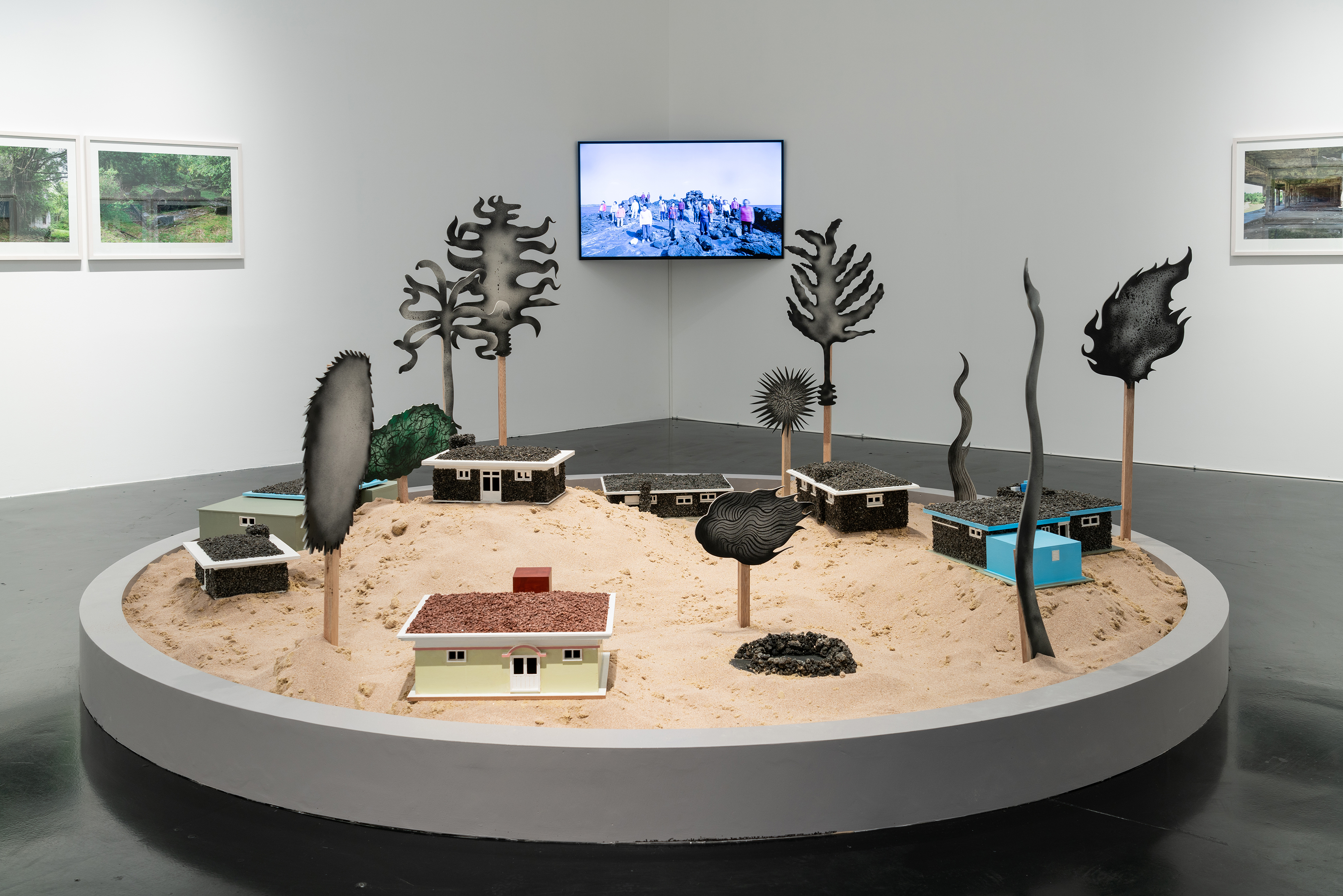 Seaweed Story (2022) @Ikkibawikrrr